
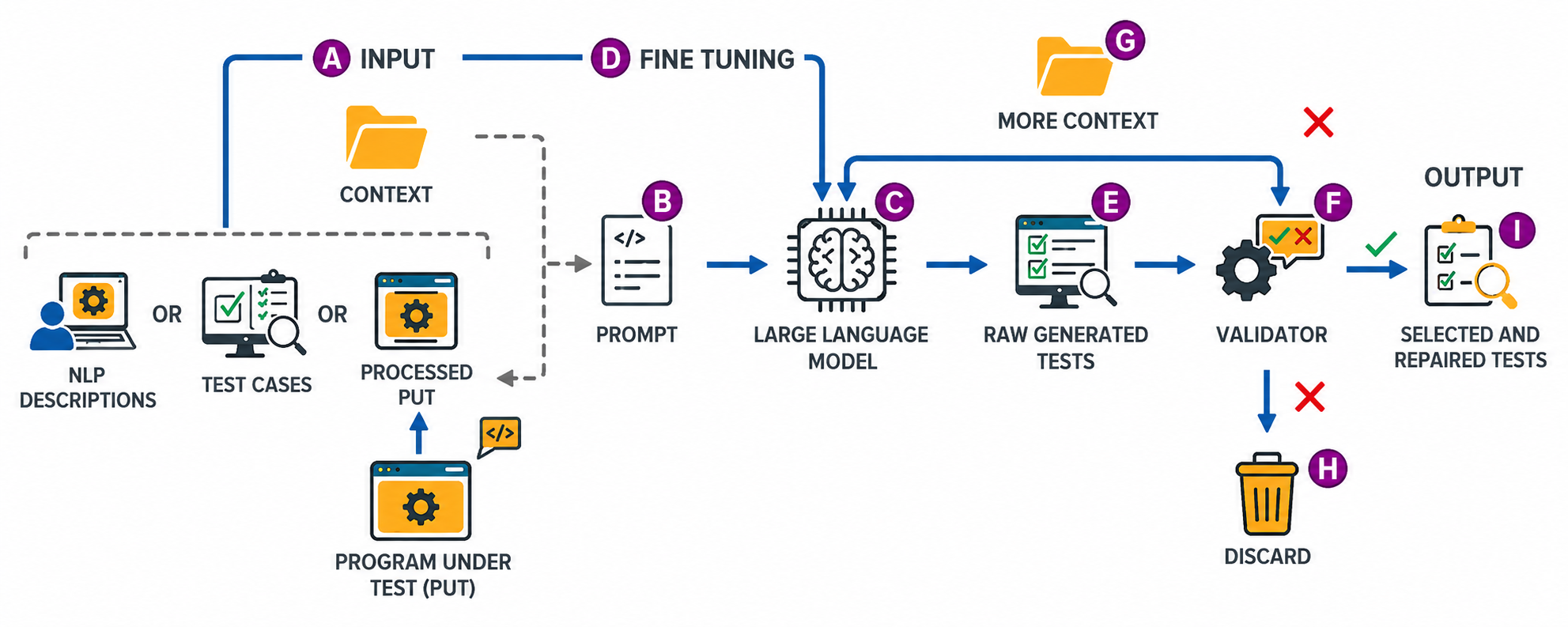
LLMs have largely been used for the generation of unit test cases. The process in general is as below
A
The input to unit test case generation are below, combined in different ways
- Program under test (PUT)
- Functionality textual descriptions: like bug reports, documentation, commit messages, bug patches, requests in natural language.
- Pre-existing test cases
- Context: such as examples of desired output, test method signature, error feedback.
All of the above inputs are placed into the crafted prompt which is then used to query the LLM to generate the unit test cases.
C, DThe LLM can be a general-purpose model (e.g. ChatGPT, Gemini) or a fine-tuned version. The fine-tuning is done with examples of test cases.
E, F, G, HThe LLM produces one or more test cases, involving a validation phase which will either 1) discard the test case or 2) iteratively improve the test case by feeding the generated context back to the LLM.
IThe final output is 1 or more validated unit test cases.
To endUnit test generation using LLMs would have to be integrated with existing tools, for instance, combining with LLM data generation tool, enhancing with ML approaches to detect hallucinations and improve LLM output.